The World of Exandria
Overview
Exandria is the name of the world on which most events of Critical Role take place. Exandria exists in a Material Plane, although it features connections to other planes of existence, such as the portals to the elemental planes guarded by the Ashari. Since the gods first came to Exandria, there have been three distinct ages: the Founding, the Age of Arcanum, and the Era of Reclamation. For a timeline of Exandrian history as it is now known, with dates, see the article Timeline.
History
The Founding
The Founding is widely considered the first age of Exandria, which started when the deities arrived on the planet, which was already home to a race of titans. During this time, the gods brought forth creatures to inhabit Exandria, before splitting into two factions in the war against the Primordial Titans: the Prime Deities and the Betrayer Gods. The age ended with the defeat of the Primordials, along with the Betrayer Gods, which made the world safe for civilization to flourish. With peace finally achieved, the first true civilization was able to take root. It was called Vasselheim, the “Dawn City” and the “Cradle of Creation.”
The Age of Arcanum
The Age of Arcanum was the second epoch of Exandria. During this time, mortals tested the limits of arcane power, challenged the gods who had created them, and brought about the escape of the once-defeated Betrayer Gods. Mortal mages grew ever more powerful, building entire castles in a day and even learning to create life-forms of their own. Driven by the quest for immortality, an unnamed mortal woman challenged and defeated the God of Death himself, ascending to take his place in the pantheon. One man, Archmage Vespin Chloras, sought to harness the power of the Betrayer Gods. He broke open their prison and released them back into the Material Plane during an apogee solstice.
The Calamity
The Calamity marked the end of the Age of Arcanum, and brought about the end of that age. It lasted about two hundred years, though exact records do not exist. This was the second war against the Betrayer Gods, which devastated civilization, killed ⅔rds of the people on Exandria, and in some cases rearranged the geography of the world.
The Divergence
Hoping to seal away the Betrayer Gods for good, the Prime Deities retreated from the Material Plane. Behind themselves and their defeated brethren, they erected a barrier known as the Divine Gate, which would prevent any god from physically crossing over into mortal realms. The departure of the gods from Exandria, and the diminishing of their influence, was an event that has since come to be known as “the Divergence.”
The Era of Reclamation
This timespan extends from the Divergence to 843 years later, when the gods shattered the Divine Gate and fled into mortal forms bound to Exandria to escape the impending release of Predathos.
Calendar
An Exandrian year lasts 328 days over the course of 11 months. Each day is 24 hours in length and the 7 days of the week are named Miresen, Grissen, Whelsen, Conthsen, Folsen, Yulisen, and Da’leysen. Yulisen and Da’leysen are considered to be the weekend for many people in Exandria.
The most commonly used, modern calendar counts the years starting with the year 0 PD (Post-Divergence). However, since the events of the Apogee Solstice in 843 PD, some people have started counting years from 0 NE -- for the “New Age.”
| Month | Days | Holidays |
|---|---|---|
| Horisal | 29 | New Dawn (1st) Hillsgold (27th) |
| Misuthar | 30 | Day of Challenging (7th) |
| Dualahei | 30 | Renewal Festival (13th) Wild’s Grandeur (20th) |
| Thunsheer | 31 | Harvest’s Rise (11th) Merryfrond’s Day (31st) |
| Unndilar | 28 | Deep Solace (18th) Zenith (26th) |
| Brussendar | 31 | Artisan’s Faire (15th) Elvendawn, or Midsummer (20th) |
| Sydenstar | 32 | Morn of Largesse (14th) Highsummer (15th) |
| Fessuran | 29 | Harvest’s Close (3rd) |
| Quen’pillar | 27 | The Hazel Festival (10th) Civilization’s Dawn (22nd) |
| Cuersaar | 29 | Night of Ascension (13th) Zan’s Cup (21st) |
| Duscar | 32 | Barren Eve (2nd) Embertide (5th) Day of Heart and Hearth (16th) Winter’s Crest (20th) |
Geography
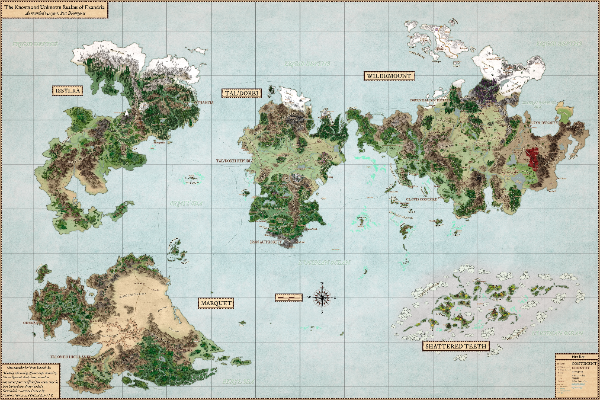
Continents
Tal’Dorei
Previously known as Gwessar, Tal’Dorei is a northern continent that includes the Republic of Tal'Dorei (including the former city-state of Whitestone), as well as the dwarven stronghold of Kraghammer, the elven realm of Syngorn, and, far to the south, the hobgoblin empire of the Iron Authority.
Issylra
A continent northwest of Tal’Dorei that is dominated by the country of Othanzia, which includes Vasselheim and Pyrah. Elsewhere on the continent is the Demithore Valley.
Marquet
A continent to the south of Issylra and southwest of Tal’Dorei. Before the Calamity, it was lushly forested. Centuries after the Divergence, it is covered mostly with desert landscapes and mountainous terrain, sheltering rare bastions of civilization. One-third of Marquet is covered with deserts.
Wildemount
Located to the east of Tal’Dorei, this continent contains the trade-oriented Clovis Concord to the west along the Menagerie Coast, the austere Dwendalian Empire within Western Wynandir, and the secretive Kryn Dynasty in Eastern Wynandir.
Domunas / The Shattered Teeth
During the Age of Arcanum, the continent of Domunas held the town of Toramunda which later split into the flying city of Avalir and its terrestrial sister city Cathmoíra. The landmass was destroyed on the eve of the Calamity, leaving behind the Shattered Teeth. Centuries after the Calamity, the Shattered Teeth is an archipelago of 43 islands southeast of Tal’Dorei, beyond a fog bank called the “Fool's Curtain”.
Additional Features
Oceans
- Beryl Sea: The ocean to the south of Marquet.
- Frigid Depths: The cold ocean to the north of Issylra, Tal’Dorei, and Wildemount.
- Lucidian Ocean: A vast ocean to the south-east of Tal’Dorei and south of Wildemount, containing the Shattered Teeth.
- Ozmit Sea: The sea separating Tal’Dorei from Issylra and Marquet to its west.
The shortest trip from Issylra to Wildemount by ship would be westward. It would take weeks, and the waters wouldn’t offer smooth sailing. There are also rumours of nations and cultures under the sea that are largely separated from the surface world and are little explored.
Underdark
The Underdark is a vast subterranean region that exists below the continents of Exandria. A dark and hostile place, the Underdark is almost a world unto itself, with civilizations, monsters, politics, economies, and threats that may interact only sporadically or indirectly with the surface world. Notably, the Underdark has significant connections to the Far Realm, from which many aberrations emerge.
Satellites
Exandria has two moons, named Catha and Ruidus. Though often depicted close to each other, Catha and Ruidus have different orbits and can appear at different points in the sky.
On extremely rare occasions, both moons can be involved in a “double eclipse” of Exandria’s sun, potentially causing a collision of multiple planes in the area under their shadow and allowing large numbers of creatures to cross even from the Outer Planes to Exandria.
Catha
Catha is similar in appearance to Earth's Moon, though it is closer to Exandria and appears larger in the sky. It has a 30 to 40 day cycle during which it waxes and wanes.
Ruidus
Ruidus appears smaller in Exandria’s sky due to its further distance from the planet, and its reddish-purple, maroon-brown colour contributes to a dimmer glow.Lycanthropy is relatively unaffected by this moon in comparison with Catha. It has a very slow orbit, taking around six months (up to 182 days) for a revolution, and is visible for about half of the year. Myths and rumour about Ruidus abound. There is a standard belief in various cultures across Exandria of it being an entity of ill-omen.
It is now known that Ruidus was home to an entity called “Predathos” that threatened the existence of the gods. It is also home to a number of sentient species.
Ruidians
Bormodos
Bormodos are one of the sentient species who inhabit the red moon Ruidus, known for having two pairs of arms and for their symbiotic relationship with cytaa. Bormodos are short, squat humanoids no more than four feet tall. Their faces are rotund and cherub-like, and they have black eyes with little visible sclera, an elephantine flesh nub with thin slitted nostrils for a nose, and deeply-set mouths. They have two pairs of arms: one is strong with meaty hands and fingers, and the other is thinner, more delicate, and more expressive. When they blush, they turn purple.
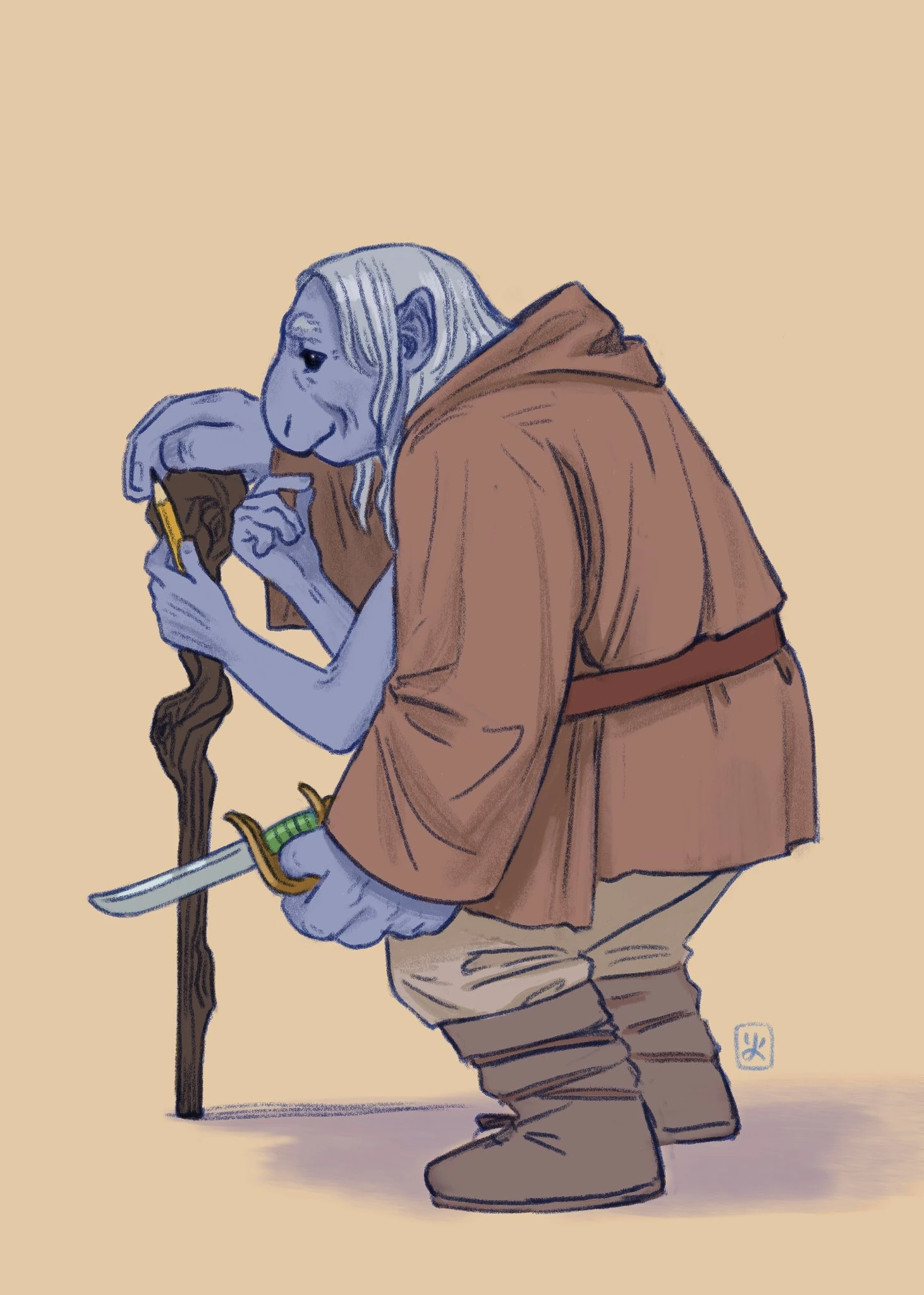
They share a symbiotic relationship with another sentient race, the cytaa, keeping them warm and fed in exchange for their hygiene and watch services; traditionally the bormodo-cytaa pair bond when they are young, but if the cytaa were to die, for example, the bormodo would bond with a new partner. Bormodos are viviparous, and their method of conception is not very different from that of an average Exandrian humanoid.
Bormodos have been told they do not themselves dream, but share the dreams of various Exandrians, whom they call “Dreamers”. This has instilled many of them with a deep longing and appreciation for, as well as insight into, Exandria and its people.
Cytaas
Cytaas are an iguana-like sentient species of Ruidus, known for their symbiotic relationship with bormodos. They are lizard-like creatures with thick scaled hide and thin limbs and bodies, looking similar to iguanas with gold shimmering eyes (although they can manifest other colours) and with somewhat fey-like features including long thin ears. They have tails that can be long or short, sometimes curling into a spiral.
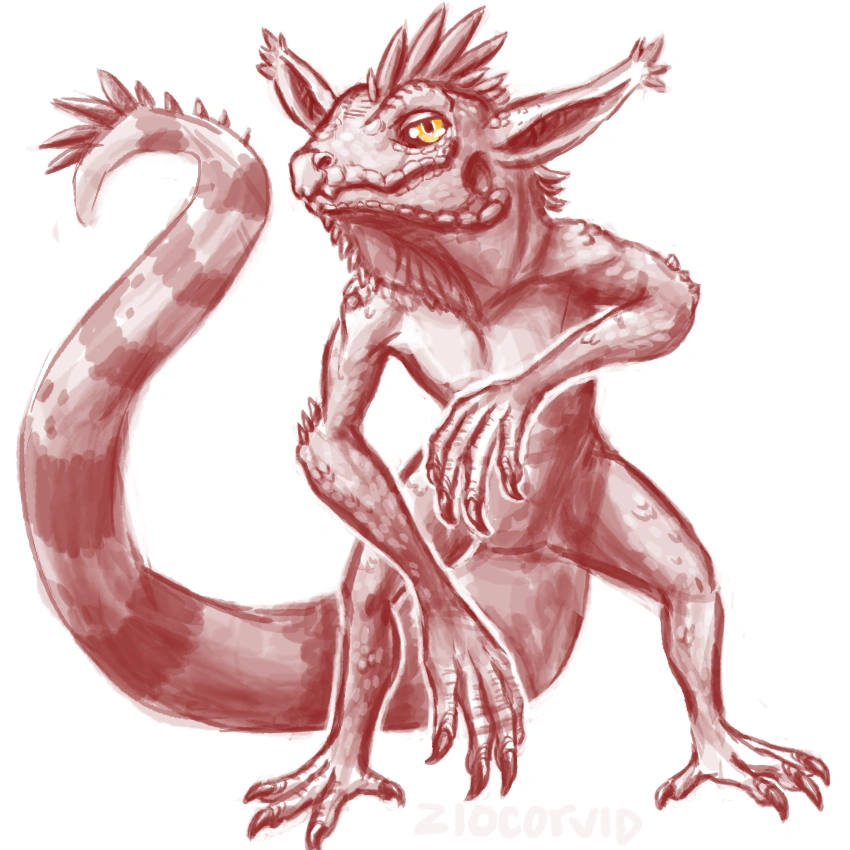
Traditionally a cytaa bonds with a young bormodo who teaches and cares for it by keeping it warm and feeding it, and in return the cytaa helps clean the bormodo, acts as a companion and occasional advisor, and watches over them. Cytaas are small enough to live cradled on the chests of their bonded bormodo. At least some cytaas are able to sense if their bormodo is still alive, as well as their proximity.
Myceits
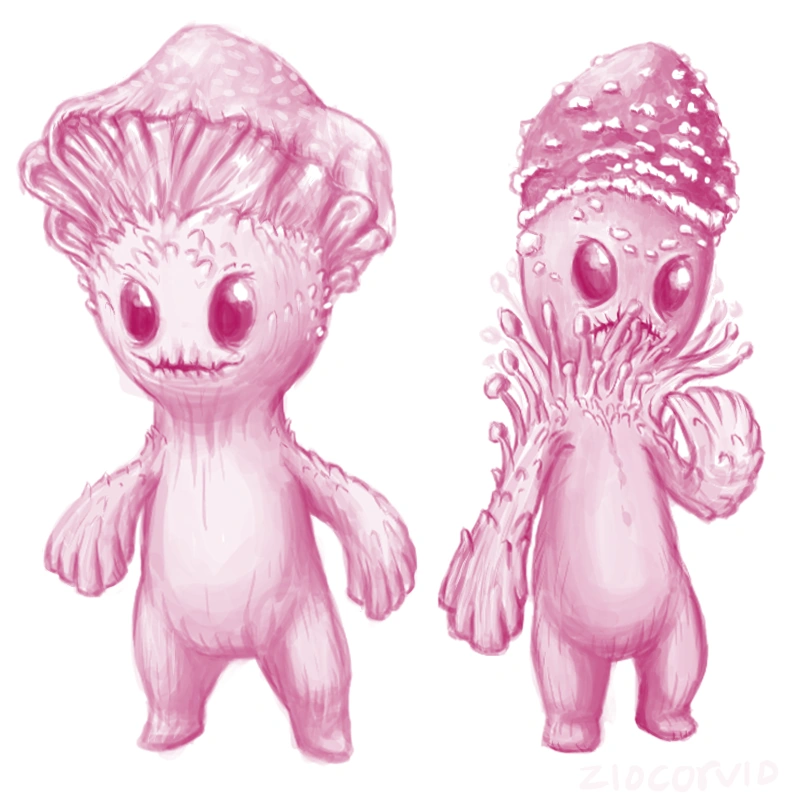
Myceits are small, approximately two-foot tall bipedal sentient creatures which are native to Ruidus and bear a resemblance to Exandrian fungus. As a sentient creature, they are not eaten for food; however, some are kept as pets by other Ruidians.
Note
The Myceit “core” has been affected by a sample taken from the cerebrum of the All-Minds-Burn in Bassuras. It is unknown what effect this may have on either the core, or on other Myceits.
Myceit appearance varies, with some having flaring caps like mushrooms, others having no caps at all, and some bearing bisected floppy caps with an eye in each half. Their skin has a gum-like or doughy texture. On Ruidus, the Myceits inhabit the tunnels and spaces between the cities and the core of the red moon.
Myceits seem to share a collective consciousness through a network of mycelium. Individual Myceits appear to understand spoken Common, but do not use it to communicate, instead verbalizing in coos and gurgles that are actually similar to a very limited form of Primordial. Using this limited verbal communication, they are able to express basic concepts such as agreement, disagreement, or question. When networked with one-another, Myceit colony organisms may communicate with colours, or through telepathy.
Quanikkas
Quanikkas are one of the sentient species of Ruidus, displaying some telepathic abilities like the reilora. They are about 8 feet tall, very thin, bipedal, with claws on fingers and toes. Their bodies are covered in grey and white fur that turns completely white with age, and tusks that can grow either straight, curved, or both. Despite being completely covered in fur, as they get old they can lose hair and become partially bald.
Reilora
Reilora or reilorans are crimson entities who inhabit the red moon Ruidus, born in the image of Predathos. According to Ruidian mythology, reilorans, like the bormodos, were carved from the rock of the moon and shaped by Predathos. Originally, all reilora were of one form, but when the Weave Mind came into power they began altering reilorans through genetic engineering, and developed the juggernauts “as well as the many other deviations of the standard reiloran physicality.” The Weave Mind’s psychic powers helped them interact with their environment and control other creatures, and eventually they created a political faction, the Imperium, as well as a city, Kreviris, at some point before 343 PD. They expanded, taking control over other regions and settlements, and their government kept the population connected with Predathos through dreams.
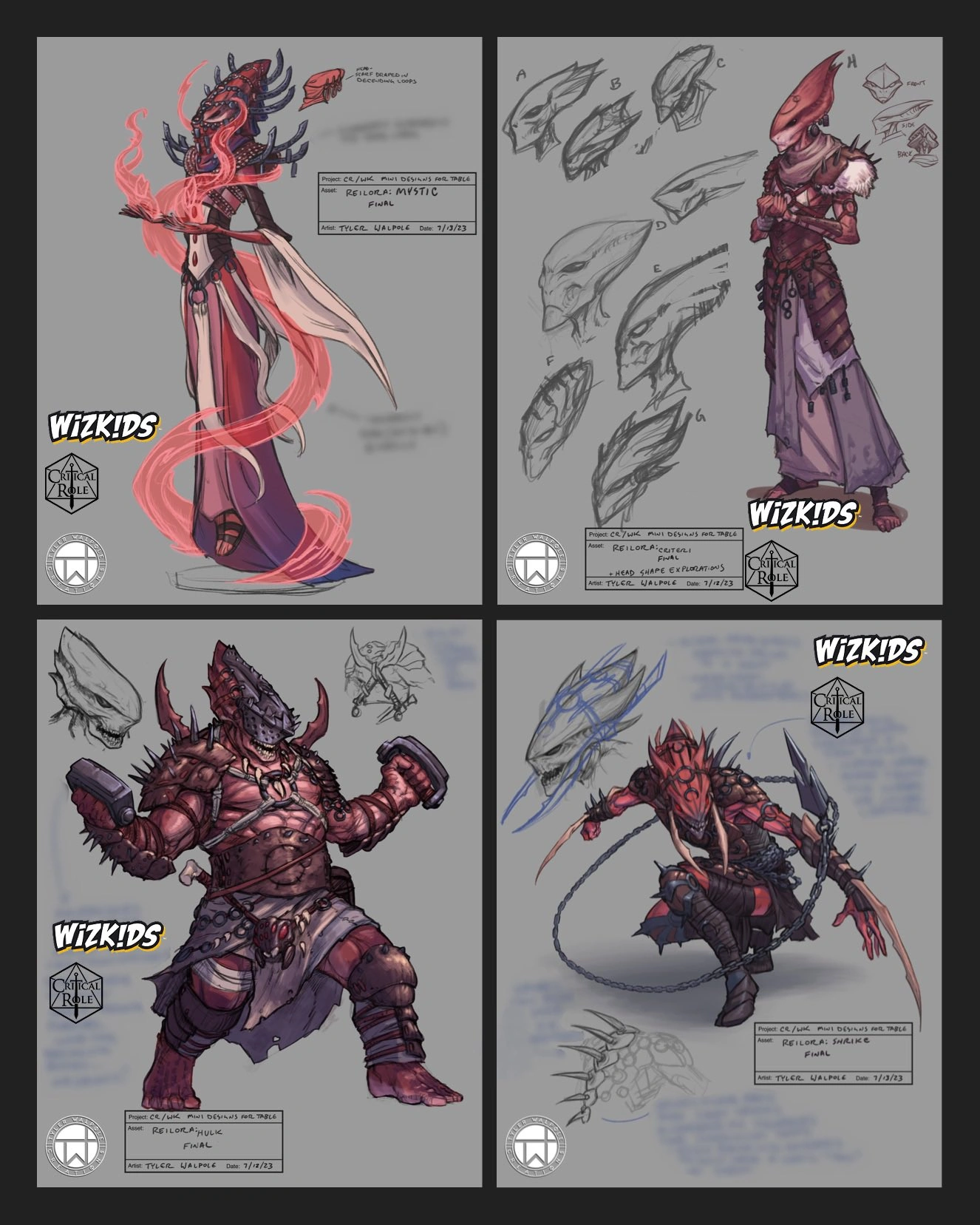
All reilorans have an elongated head stretching backward into one or more points that generally curl upward. They have proportionally long arms with long fingers that are tipped in claws, broad shoulders, and long necks. Their faces are pointed, resembling a shark, with dark iridescent purple eyes, nose slits, and a small mouth with pointed teeth. They have deep red skin with striations around major muscles, long arms darker in colour, and silvery veins. At least some reilora exhibit a degree of sexual dimorphism, with hex mind females having a finer bone structure and a divided head crest. As reilora age, their head crests grow and become more prominent, and their skin becomes grey and less intensely coloured.
The Weave Mind spent several hundred years genetically manipulating the reilorans to eventually create at least 4 known types: Hex Minds, Juggernauts, Shrikes, and Thought Eaters.
At least some reilorans have innate psychic and magical abilities. It is unknown whether these are natural to the species, or the result of genetic or magical enhancement.